
Singapore · street tea stalls
Singapore: tea between two mugs
What a customer remembered about Waterloo Street was a stream of tea caught in a second vessel. The sight drew the eye, but the movement also changed what the customer drank.
What the customer remembered
In a 2005 interview for the National Archives of Singapore, Rudolph William Mosbergen recalled the food stalls on Waterloo Street. One that stayed with him was a sarabat stall, a drinks stand. As the vendor poured the tea, the distance between the vessels grew. What fascinated Mosbergen was that the whole stream still landed in the receiving vessel. Years later he could describe a gesture more precisely than most customers could recite an ingredient list.
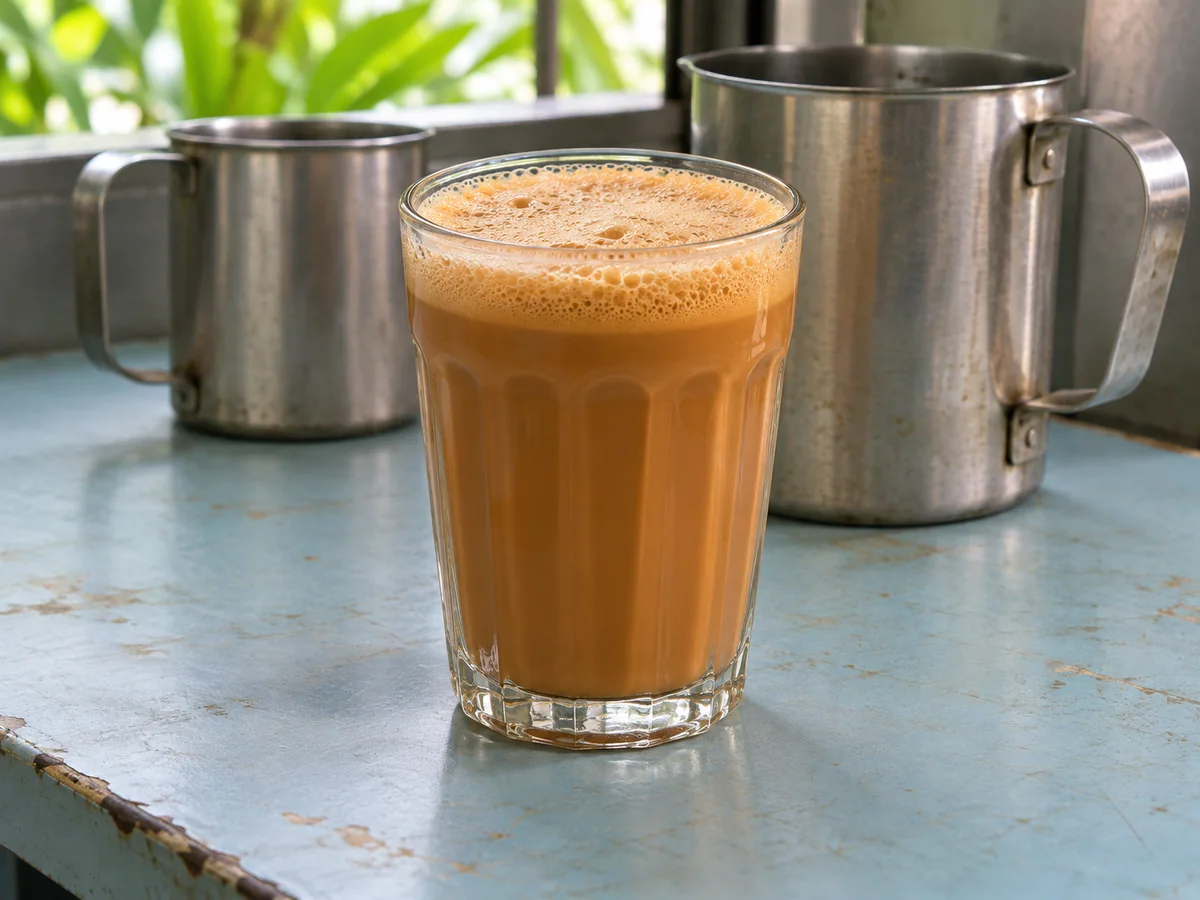
Teh tarik means “pulled tea”. Singapore’s heritage inventory connects it to Indian migrants and describes milk tea poured to develop a smooth froth. Even someone who missed the pour gets the milky sweetness and the bubbles. For someone standing at the stall there is a further pleasure in recognising a practised movement.
Listening to the order
A heritage trail through Kampong Glam records another example. On Baghdad Street, proprietors from Uttar Pradesh in India had been serving teh halia, ginger tea, since the 1950s. This is evidence about particular people and a particular place. It does not make one Singapore stall the birthplace of all teh tarik. It does show how a street address can come to stand for a flavour.
Regulars also have a compact vocabulary for ordering. In the same inventory, teh O means sweet tea without milk, while teh O kosong leaves out both milk and sugar. For a newcomer, one extra word changes the whole cup. Try writing a home menu with that precision: what kind of tea, whether it contains milk, how sweet it is. The high pour can stay in practised hands; knowing how to order is a fine place to start.