
Texas and Brooklyn · 1883–1884
How the strainer became part of the shaker
William Murphy put a strainer on a hinge. Edward Hauck tucked his under a cap. Two American patents show how a bartender could pour a drink and leave the ice behind.
A lid on a hinge
Picture the last few seconds before serving. You have a shaker full of drink and ice in one hand and an empty glass waiting on the counter. Where did you put the strainer? In January 1883, William Murphy of Brenham, Texas, was granted a patent for a shaker. His specification mentions just this annoyance. A separate strainer costs money and can be out of reach when you need it.
In Murphy’s drawing, the perforated lid swings out of the way so an inverted drinking glass can fit inside the mouth of the metal cup. The bartender could shake with the two vessels joined, take the glass out, then swing the lid shut over the cup and pour through its holes. A spring held the lid in either position.
Why Hauck added a bent tube
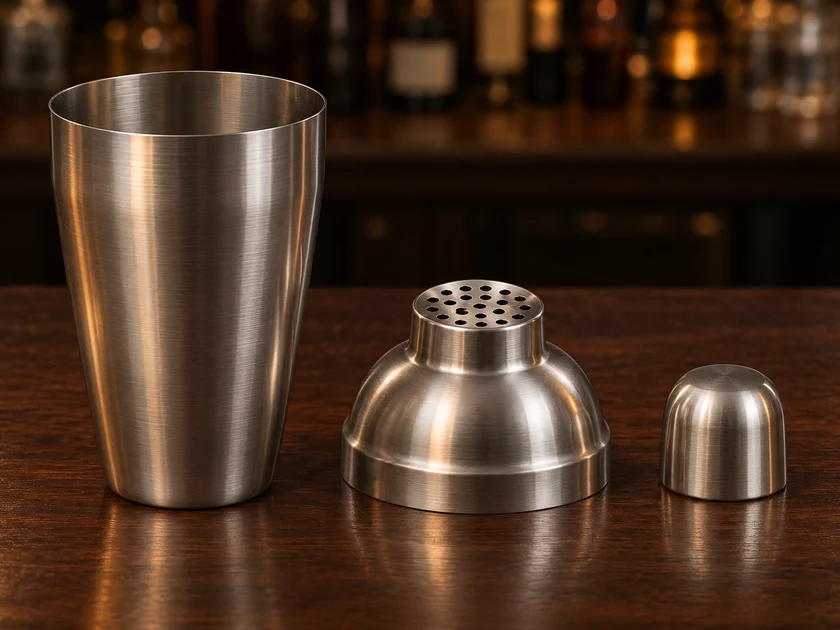
On 24 June 1884, Edward J. Hauck of Brooklyn received a patent for a shaker with a different top. In the sectional drawing you can pick out the three pieces familiar today. A is the vessel, B the bell-shaped lid and D the little cap. C marks the strainer fixed inside the lid. Lift the cap to pour and the lid and strainer stay where they are.
Hauck spent much of his explanation on a feature barely visible from the outside. Pressing the cap into place compressed the air inside. The resulting pressure, he wrote, could lift the fittings enough to spill drink onto the counter. Look inside the detached lid in his second drawing. A tube gave the air a way out, while its upturned end kept liquid from spurting through the vent. The familiar outline tells only half the story of this particular shaker.
The last movement in a Daiquiri
In the Atlas Daiquiri, rum, lime juice and dissolved sugar are shaken with ice cubes. The serving glass is chilled in advance and gets no cubes of its own. If you have a three-piece shaker, take off the little cap, keep a hand on the broad lid and tip the shaker over the glass. The drink runs through the holes while the cubes stay behind. That last movement is enough to recognise the top of Hauck’s shaker in his drawing.